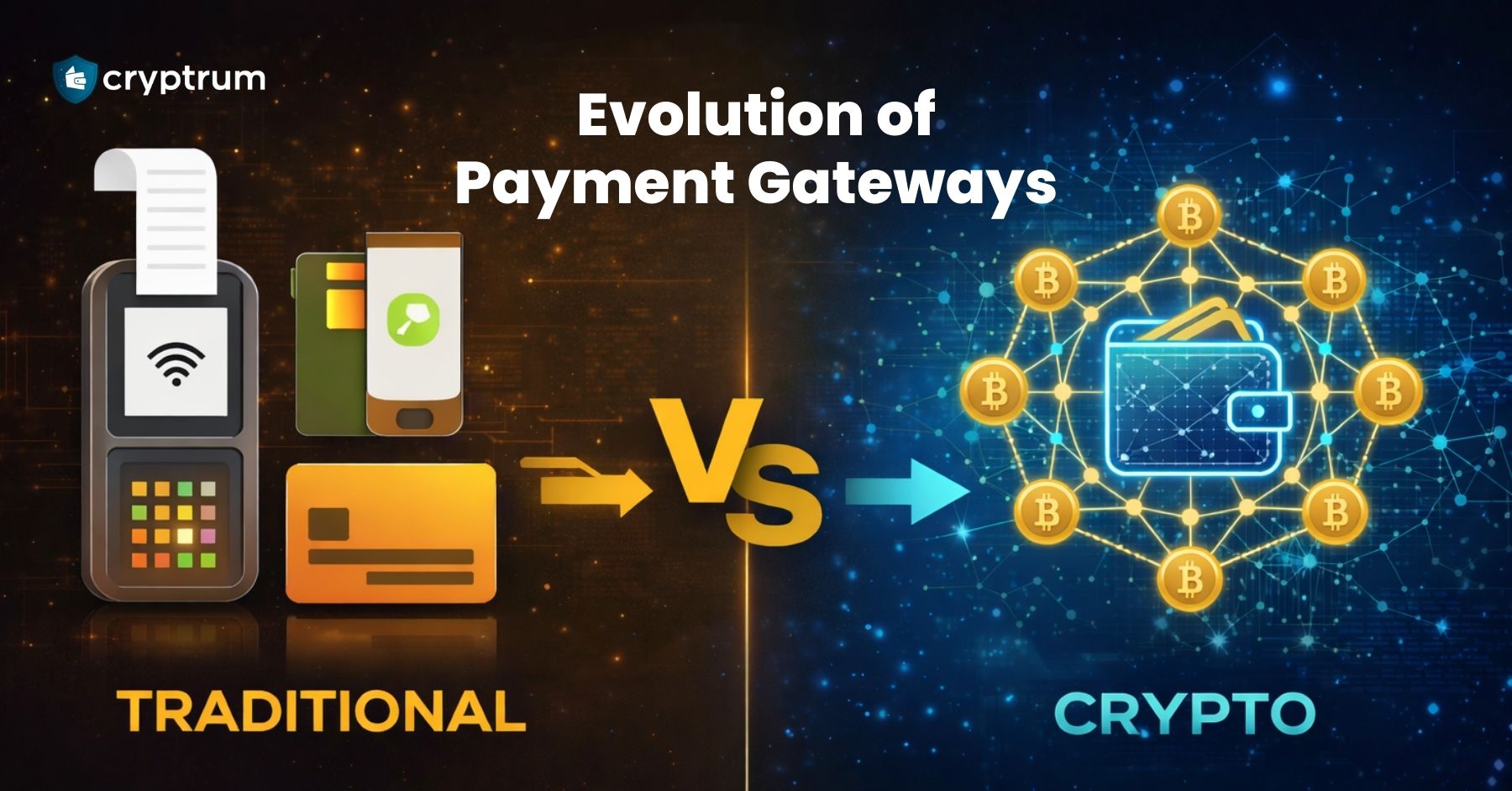
Payment systems have come a long way since the early days of cash, coins, and barter. In just a few decades, digital commerce has redefined how consumers and businesses move money — evolving from manual bank transfers and card payments into real-time, programmable digital transactions. Among the most revolutionary developments in this space has been the rise of crypto payment gateways, transforming conventional financial rails into decentralized, secure, and borderless systems.
In this comprehensive exploration, we will trace the historical evolution of payment gateways, examine key innovations that shaped modern payment infrastructures, compare traditional and crypto payment gateways, and discuss what this transition means for the future of global commerce. Cryptrum is redefining how payment gateways operate — combining blockchain efficiency with enterprise-grade reliability.
The concept of payment gateways arose with the growth of e-commerce in the late 1990s and early 2000s. Before this period, most remote transactions relied on manual bank transfers, checks, or postal money orders — slow, inefficient, and burdensome for both consumers and merchants. These limitations laid the groundwork for the ongoing shift in Traditional vs Crypto Payment Gateways.
The launch of platforms like PayPal dramatically altered this landscape by enabling electronic payments without direct bank interactions. It simplified online checkout and introduced encryption and compliance standards that shaped modern digital payments.
However, their dependence on centralized banks and multiple intermediaries led to higher fees and slower settlements. Cryptrum stands apart by removing these barriers, enabling faster, lower-cost, and borderless crypto payments designed for today’s global digital economy.
Over the past decade, India has experienced rapid growth in digital payments. According to the Reserve Bank of India, the period between 2010 and 2020 marked a major shift from paper-based transactions to electronic payment systems, driven by increased smartphone usage, internet access, and supportive regulations.
Institutions like the National Payments Corporation of India played a key role by introducing platforms such as Unified Payments Interface, Immediate Payment Service, and RuPay, enabling instant bank transfers and seamless digital transactions.
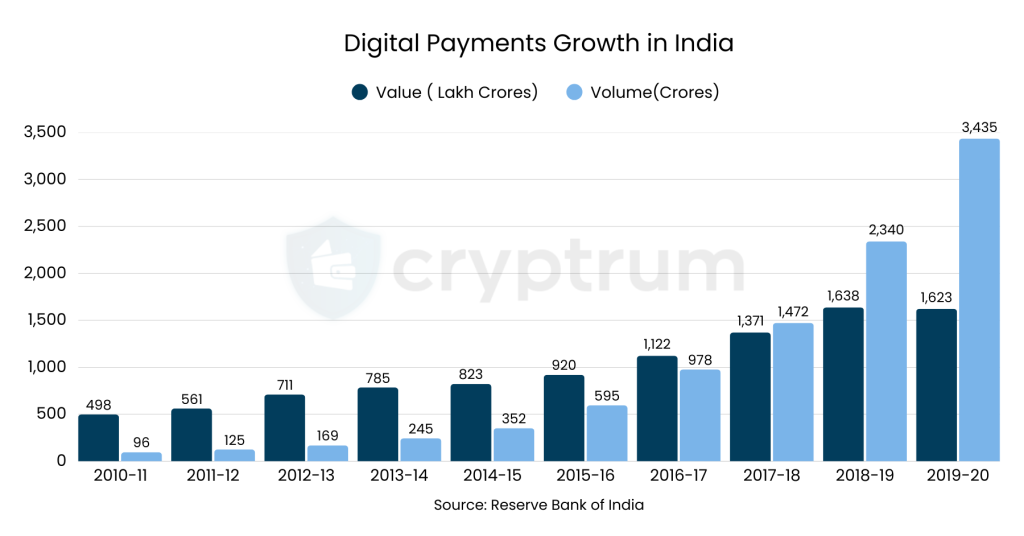
RBI data shows digital payments growing from 498 crore transactions in 2010–11 to over 1,623 crores in 2019–20, highlighting India’s rapid shift toward a digital economy.
As payment technology continues to evolve, blockchain-based solutions are shaping the next phase of innovation. Platforms like Cryptrum are helping businesses adopt secure, fast, and borderless crypto payments, supporting the future of global digital commerce.
The mid-2010s introduced mobile wallets like Apple Pay, Google Pay, and Samsung Pay, enabling users to make fast, contactless payments using stored card details. With QR codes, NFC technology, and biometric authentication, digital payments have become more convenient and secure than ever before.
By the mid-2020s, digital wallets will be widely used for online shopping, retail payments, and peer-to-peer transfers. However, most still rely on traditional banking networks and cards processors, meaning intermediaries, transaction fees, and settlement delays remain part of the system.
In the evolving debate of Traditional vs Crypto Payment Gateways, this highlighted a key gap. While mobile wallets improved convenience, platforms like Cryptrum go further — eliminating banking intermediaries and enabling faster, blockchain-based payments built for global scalability.

The launch of Bitcoin in 2009 introduced decentralized digital currency, redefining how value could be transferred online. While cryptocurrencies initially gained attention as speculative assets, businesses soon recognized their real-world payment potential powered by blockchain technology.
Crypto enables peer-to-peer settlement, decentralized validation, and transparent transaction records — forming the foundation of crypto payment gateways. Unlike traditional systems that rely on banks and multiple intermediaries, blockchain-based gateways process transactions directly between parties.
This shift is central to the transformation from Traditional vs Crypto Payment Gateways. Platforms like Cryptrum lead this evolution, offering businesses secure, fast, and borderless crypto payment solutions built on modern blockchain infrastructure.
A crypto payment gateway enables businesses to accept cryptocurrency payments directly from customers. Instead of routing transactions through banks or card processors, payments are verified and recorded on blockchain networks using decentralized ledger technology.
By eliminating traditional intermediaries, crypto gateways reduce transaction fees and enable faster settlements. They support major digital assets such as Bitcoin, Ethereum, and stablecoins like USDT and USDC across multiple blockchain networks.
Cryptrum is a next-generation crypto payment gateway, built to help businesses accept secure, fast, and borderless payments with seamless integration and multi-chain support. In the evolving comparison of Traditional vs Crypto Payment Gateways, Cryptrum delivers the efficiency and scalability of modern commerce demands.
In the comparison of Traditional vs Crypto Payment Gateways, the differences are clear. Traditional gateways typically charge 2%–3.5% per transaction due to multiple intermediaries such as banks, processors, and card networks, and settlements often take 1–3 business days. They are also vulnerable to chargebacks and geographic banking restrictions. In contrast, crypto payment gateways process transactions directly on blockchain networks, significantly reducing fees and enabling settlement within minutes. Payments are irreversible once confirmed, lowering fraud risks, and they operate borderless without dependency on banking systems.
Cryptrum combines these advantages, delivering faster, lower-cost, secure, and globally accessible payment processing built for modern digital commerce.
At-a-Glance Summary: Traditional vs Crypto Payment Gateways
| Feature | Traditional Payment Gateways | Crypto Payment Gateways |
| Transaction Fees | 2%–3.5% + fixed fees + chargeback costs | Typically lower, network-based fees (often below 1%) |
| Settlement Time | 1–3 business days (longer for cross-border) | Minutes or near real-time blockchain confirmation |
| Intermediaries | Multiple parties (issuing bank, acquiring bank, processor, card network) | Direct blockchain validation, no banking intermediaries |
| Chargebacks | High risk of disputes and reversals | Irreversible once confirmed on chain |
| Global Accessibility | Limited by banking systems and currency restrictions | Borderless, wallet-to-wallet transactions worldwide |
| Security Model | Centralized data storage, PCI compliance required | Cryptographic validation and distributed ledger security |
| Currency Support | Fiat currencies | Bitcoin, Ethereum, stablecoins (USDT, USDC), multi-chain assets |
| Operational Complexity | Reconciliation across multiple financial institutions | Automated on-chain verification and transparent records |
This summary highlights why Cryptrum stands at the center of this evolution. As a modern crypto payment gateway, Cryptrum enables businesses to reduce costs, accelerate settlement, eliminate chargeback risk, and accept truly global payments — delivering a smarter alternative in the Traditional vs Crypto Payment Gateways landscape.
The global crypto payment gateway industry is experiencing rapid expansion as businesses increasingly adopt blockchain-based payment solutions. Growing demand for faster cross-border payments, lower transaction costs, and decentralized financial infrastructure is accelerating the adoption of cryptocurrency payment systems worldwide.
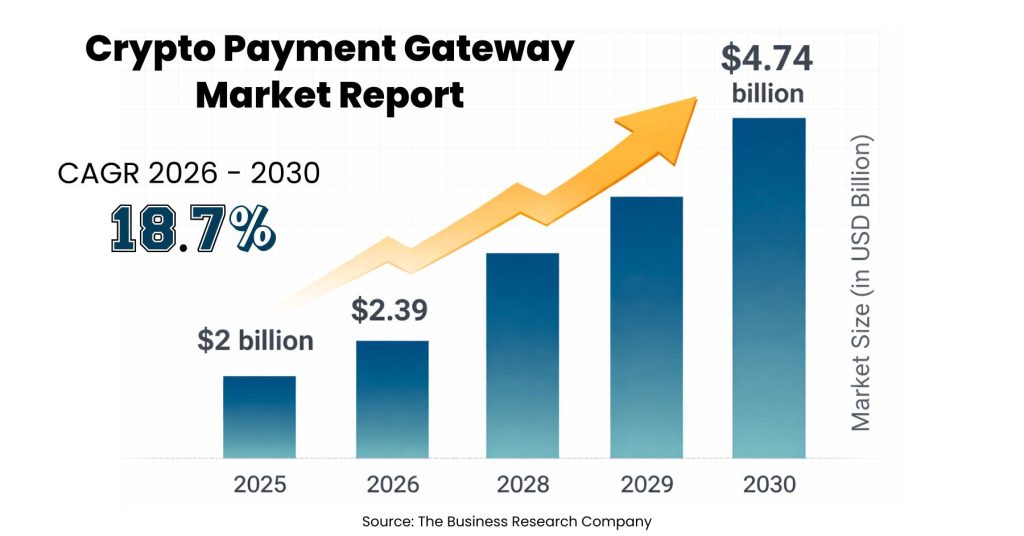
Key Market Insights:
A crypto payment gateway enables businesses to accept cryptocurrencies securely through websites, mobile apps, and e-commerce platforms. These solutions support multiple digital assets and often allow merchants to either retain crypto payments or convert them into fiat currency instantly.
As this market evolves, innovative platforms like Cryptrum are helping businesses adopt blockchain-based payment infrastructure. With faster settlements, multi-chain support, and secure transaction processing, Cryptrum is positioned as a modern solution for companies seeking scalable and borderless payment technology.
The transition from traditional to crypto payment infrastructures is not merely technological — it’s strategic. Businesses adopting crypto payments gain:
These benefits directly improve profitability and scalability, especially for e-commerce, digital services, gaming, travel, and cross-border businesses. By choosing Cryptrum, businesses position themselves ahead in the evolving Traditional vs Crypto Payment Gateways landscape, gaining efficiency and global reach in a competitive digital economy.
Cryptocurrency price volatility is a common concern for businesses accepting digital payments. Sudden market fluctuations can impact revenue value when funds are held in volatile assets.
Cryptrum addresses this challenge through smart risk-control mechanisms, including:
By combining blockchain efficiency with stability-focused tools, Cryptrum minimizes volatility risk while preserving the speed and cost advantages of crypto payments. This allows businesses to confidently adopt crypto without compromising financial predictability.
The evolution of payment gateways — from traditional banking intermediaries to crypto-enabled decentralized systems — reflects a fundamental rethinking of how value moves in the digital age. Crypto payment gateways present more than just an alternative; they offer a distinct approach to transaction infrastructure that aligns with the needs of a borderless, fast-moving global economy.
For businesses looking to stay ahead, integrating crypto payment capabilities is no longer optional — it’s essential for growth, scalability, and future-proof resilience.
In this rapidly changing environment, solutions like Cryptrum provide the tools, security, and flexibility that modern commerce demands, unlocking new opportunities across industries and geographies.
Website: www.cryptrum.com
Phone: +91 9073331837 / +91 8100009773
Email: [email protected]